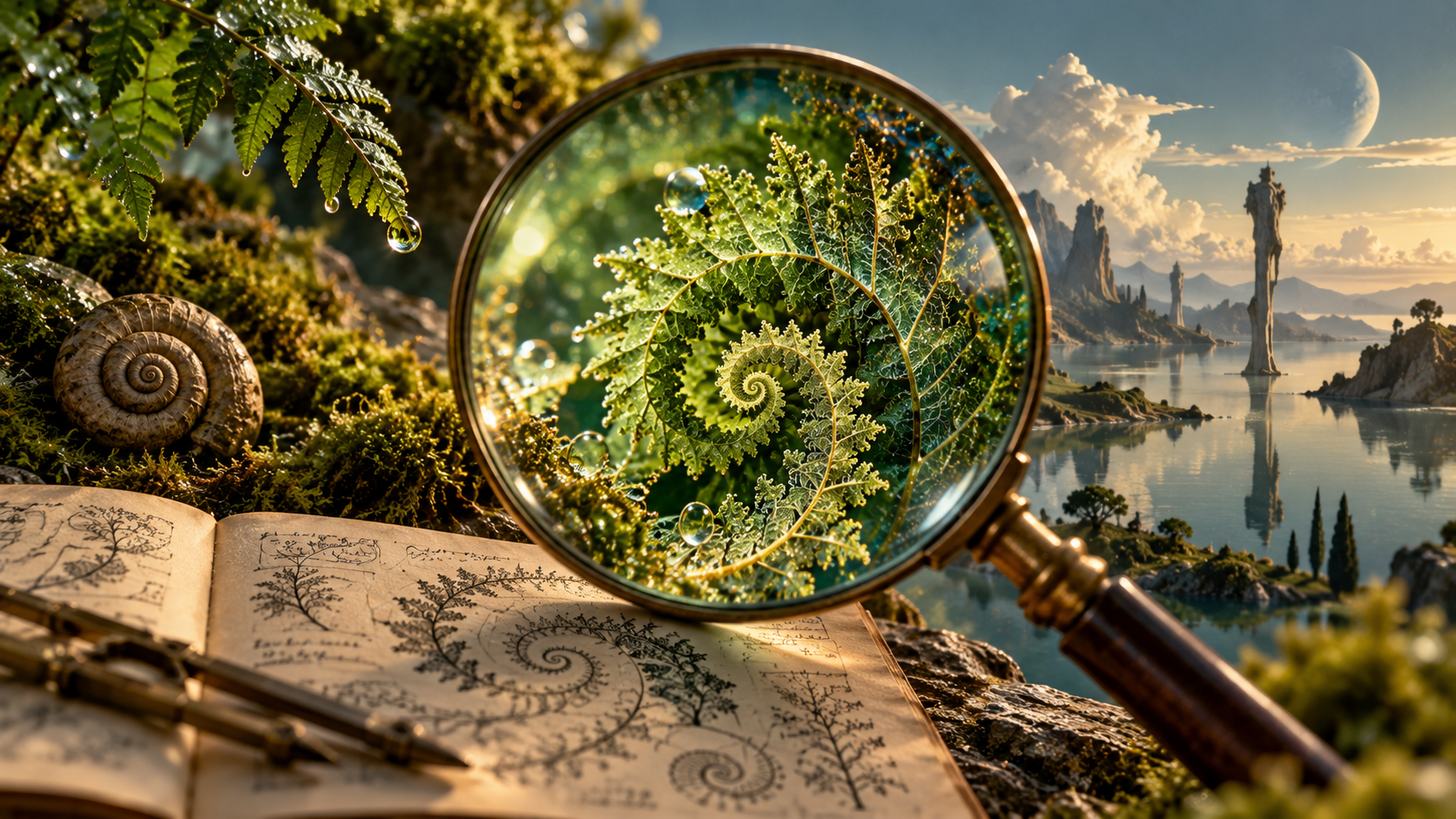
I’ve always believed in God. What I’ve never been particularly comfortable with is the notion of God as some bearded fellow sitting on a throne of clouds, keeping score of our good deeds and bad behavior, occasionally intervening in the affairs of people. I suppose there’s something reassuring about believing that an all-knowing, all-powerful being has a personal interest in how our lives turn out. But I’ve never found the idea that we are mere playthings for the gods particularly comforting.
So what, exactly, is God? It’s a question philosophers, theologians, and scientists have wrestled with for thousands of years. I certainly don’t expect to settle it here. But I do want to share an experience that fundamentally altered the way I think about the question. It began with a fractal. More specifically, the Mandelbrot set. If you’ve never seen one of these things in motion, I encourage you to stop reading and find a video of a Mandelbrot zoom. Seriously. I’ll wait.
What you’re watching is a mathematical object of extraordinary complexity. As the image magnifies, intricate structures come into view. Spirals, branching filaments, repeating shapes, patterns within patterns. Some resemble ferns, others seashells, river deltas, even the vascular systems of living organisms. The deeper you go, the more astonishing the landscape becomes. And here’s the part that got me: all of this complexity arises from an absurdly simple mathematical equation. No artist. No architect. No divine hand reaching into the machinery to make the next spiral appear. Just mathematics.
Now, I’m not suggesting that an equation can create a living organism. But watching those structures unfold, I couldn’t shake the feeling that I was witnessing something fundamental about the nature of the universe. Something that, for lack of a better word, felt divine.
Order Out of Chaos?
The Mandelbrot set takes its name from Benoit Mandelbrot, the Polish-born mathematician whose work at IBM helped establish the field of fractal geometry. In 1975, Mandelbrot coined the term fractal from the Latin fractus, meaning broken or fractured. Classical geometry is concerned with things like circles, triangles, and straight lines. Useful stuff, particularly if you’re building a house. But take a walk through the woods and you’ll notice that nature isn’t especially fond of straight lines.
Trees branch. Coastlines twist. Clouds billow. Mountains fracture. Rivers divide into tributaries, which divide into smaller tributaries. The natural world is filled with irregularities that classical geometry struggles to describe. Fractal geometry gives us a language for many of these structures. The Mandelbrot set itself is generated by repeatedly applying a simple mathematical relationship:
z(n+1) = z(n)² + c
Don’t worry. I’m only posting one equation.
The important thing is that the equation is deterministic. Given the same starting conditions, it produces the same results every time. There’s no randomness involved in the classical Mandelbrot set. And yet its boundary contains a seemingly inexhaustible variety of intricate structures. That was my first surprise. I’d always associated complexity with complication. Surely something as elaborate as a living organism required an equally elaborate set of instructions. And if something as complex as life exists, shouldn’t we expect an intelligence of even greater complexity to have designed it?
But here was mathematics demonstrating that astonishing complexity could arise from remarkably simple rules. To be clear, a Mandelbrot zoom isn’t showing us life being created. The structures are already implicit in the mathematics. We’re exploring them, not watching them evolve. Still, the implications seemed difficult to ignore. If something so simple can produce something so intricate, what else might be possible?
Nature Has a Few Tricks Up Its Sleeve
Consider the snowflake. Water vapor freezes into ice crystals under the right atmospheric conditions. Temperature, humidity, and the molecular structure of water determine how those crystals grow. Sixfold symmetry emerges, branches develop, and intricate patterns form. Nobody designs the snowflake. There isn’t a committee deciding whether this particular crystal needs another branch. The structure emerges from the interaction of matter and physical laws. (Sixfold symmetry means an object or pattern looks the same after rotating it by 60 degrees around a central point,)
Or consider the way birds flock. Thousands of individual animals can move together in sweeping, coordinated formations without a central authority directing traffic. Each bird responds to its neighbors, and from those relatively simple interactions emerges something that looks remarkably like a single organism. Scientists call this emergence: complex behavior arising from interactions among simpler components. (See Steven Johnson’s excellent book Emergence for more on the topic of emergence.)
It doesn’t mean that everything in nature is a fractal. Nor does it mean that the emergence of life is inevitable. We still don’t know precisely how nonliving chemistry first became biology. (Though Dan Brown’s Origin and the ideas behind Quantum Biology are not to be overlooked). And we certainly haven’t demonstrated that a simple mathematical equation can explain consciousness. But what we do know is that nature has an extraordinary capacity to organize itself.
Matter becomes stars. Stars manufacture the heavier elements. Those elements become planets, oceans, atmospheres, and the chemistry from which life eventually emerged—at least once, on a small planet orbiting an otherwise unremarkable star. Somewhere along the way, matter became capable of observing itself. Think about that for a moment. The universe produced something that could look back at the universe and wonder how the hell it got here. And that’s where my thoughts turn towards God.
Enter Spinoza
In the 17th century, a Dutch philosopher named Baruch Spinoza proposed an idea so radical that it got him expelled from his Jewish religious community in Amsterdam. Spinoza rejected the conventional understanding of God as a supernatural being existing apart from the universe. He didn’t believe God sat outside creation, occasionally reaching in to adjust the machinery. Instead, he proposed something quite different.
Deus sive Natura. (God, or Nature.)
For Spinoza, God and Nature weren’t separate entities. Everything that exists is an expression of one infinite, underlying reality. God doesn’t create the universe as a carpenter creates a table. The universe and everything within it follow from the very nature of God. In his Ethics, published after his death in 1677, Spinoza argued that nothing exists outside God, and that everything follows from the necessity of divine nature.
This is not quite the same as saying that God is simply another name for the collection of stars, planets, trees, and animals. Spinoza’s conception of God is more fundamental than that. God is the infinite substance of which all things are expressions. And this is where the Mandelbrot set returned to my thinking. When I watched those extraordinary patterns unfold, I wasn’t witnessing an intelligence deciding where to place each branch or spiral. Every structure was an expression of the same underlying mathematical relationship. The forms appeared distinct, but they weren’t independent creations. They were manifestations of the same mathematics.
What if the universe works something like that?
What if stars, galaxies, oceans, trees, and living organisms aren’t separate creations assembled by an external intelligence, but expressions of an underlying reality whose nature makes such complexity possible? And what if that’s what we mean when we say God?
Einstein’s God
I’m hardly the first person to find Spinoza’s thinking appealing. Albert Einstein was famously uncomfortable with the idea of a personal God who intervenes in human affairs. When asked about his religious beliefs in 1929, he replied that he believed in Spinoza’s God1, revealed in the lawful harmony of existence, rather than a God concerned with the fates and actions of individual human beings. Coming from the man who fundamentally changed our understanding of space, time, and gravity, that’s a rather interesting endorsement. 1Jewish Telegraphic Agency — April 28, 1929
Einstein saw extraordinary beauty in the mathematical order of the universe. The fact that nature could be understood at all—that its behavior could be described through mathematical relationships—was itself a source of wonder. But there’s an important distinction here. Einstein wasn’t arguing that mathematics proves the existence of God. Nor am I.
A mathematical equation doesn’t establish a theological truth. The Mandelbrot set is not evidence that God exists, any more than a snowflake is proof of divine intention. What it offers, at least to me, is a different way of imagining the relationship between God and the universe. Instead of asking who designed the complexity, perhaps we should be asking why the universe possesses the capacity to generate complexity in the first place. Science can investigate the mechanisms. It can tell us how stars form, how crystals grow, how natural selection shapes living organisms. But does explaining the mechanism exhaust the mystery? I’m not convinced it does.
Does God Need to Make Decisions?
There is, however, something about Spinoza’s philosophy that makes this whole business considerably more complicated. Spinoza’s God doesn’t make choices. At least, not in the way we understand choice. Everything follows necessarily from God’s nature. God doesn’t deliberate over possible universes, select a favorite, and set creation in motion. There is no divine preference for one outcome over another. For me that raises an uncomfortable question about free will.
If everything in the universe unfolds according to the necessity of nature, what does that say about our own ability to make decisions? It’s a question that occupied Spinoza, and one that continues to trouble philosophers and neuroscientists and me today. Robert Sapolsky, in his book Determined, argues that our choices are the inevitable consequences of prior causes—genes, environment, neurochemistry, and everything that has happened to us before.
Spinoza approached freedom differently. For him, freedom wasn’t the ability to escape causality. It was the ability to understand the causes that govern us and act through reason rather than remain enslaved to impulses we don’t understand. That may not be the sort of free will most of us imagine we possess. But perhaps the same is true of God.
We’ve spent centuries imagining a God with human qualities, only magnified beyond comprehension. A God who thinks, chooses, rewards, punishes, and occasionally changes his mind. What if those are limitations of our imagination rather than attributes of the divine? What if we’ve been trying to understand God by making God more like us, when we should have been trying to understand ourselves as part of something much larger?
The God in the Mathematics
I want to return to that fractal. As I watched the image magnify, one intricate structure gave way to another. There seemed to be no end to the complexity. No final destination. Just an ever-deepening mathematical landscape. The experience didn’t make me an atheist. Quite the opposite. It made me wonder whether the traditional distinction between creator and creation was itself misleading. Perhaps God isn’t standing outside the universe, operating the controls. Perhaps the laws, relationships, and possibilities inherent in existence are expressions of something we have been calling God all along. That doesn’t mean the universe is conscious (it might be, but we can’t go there here). It doesn’t establish that life was destined to emerge, or that human existence has some predetermined purpose. And it certainly doesn’t settle the question of why there is something rather than nothing. But it does suggest a way of thinking about God that I find far more compelling than the celestial patriarch of my childhood imagination.
Spinoza gave philosophical form to this possibility nearly 350 years ago. Einstein recognized something profound in it. And a simple mathematical equation gave me a way to begin imagining it for myself. I don’t know whether the universe requires a creator. I don’t know whether God possesses consciousness or intention in some form beyond our comprehension. And I don’t know whether the extraordinary complexity we observe in nature is inevitable or merely one possibility among countless others. But I do believe in God. What changed was my understanding of where to look.
Perhaps the greatest mistake we’ve made isn’t believing in God, but imagining that God must somehow exist apart from the universe. After all, if God is truly infinite, what could possibly exist outside God? And if the universe can produce stars, oceans, forests, and eventually creatures capable of asking why any of it exists, perhaps we should spend less time imagining God sitting above creation and more time considering what creation itself might be telling us about God. Not a God who stands apart from nature. But a God whose nature is inseparable from existence itself.
Deus sive Natura.
I wonder what Spinoza would have made of the Mandelbrot set? What do you think?
