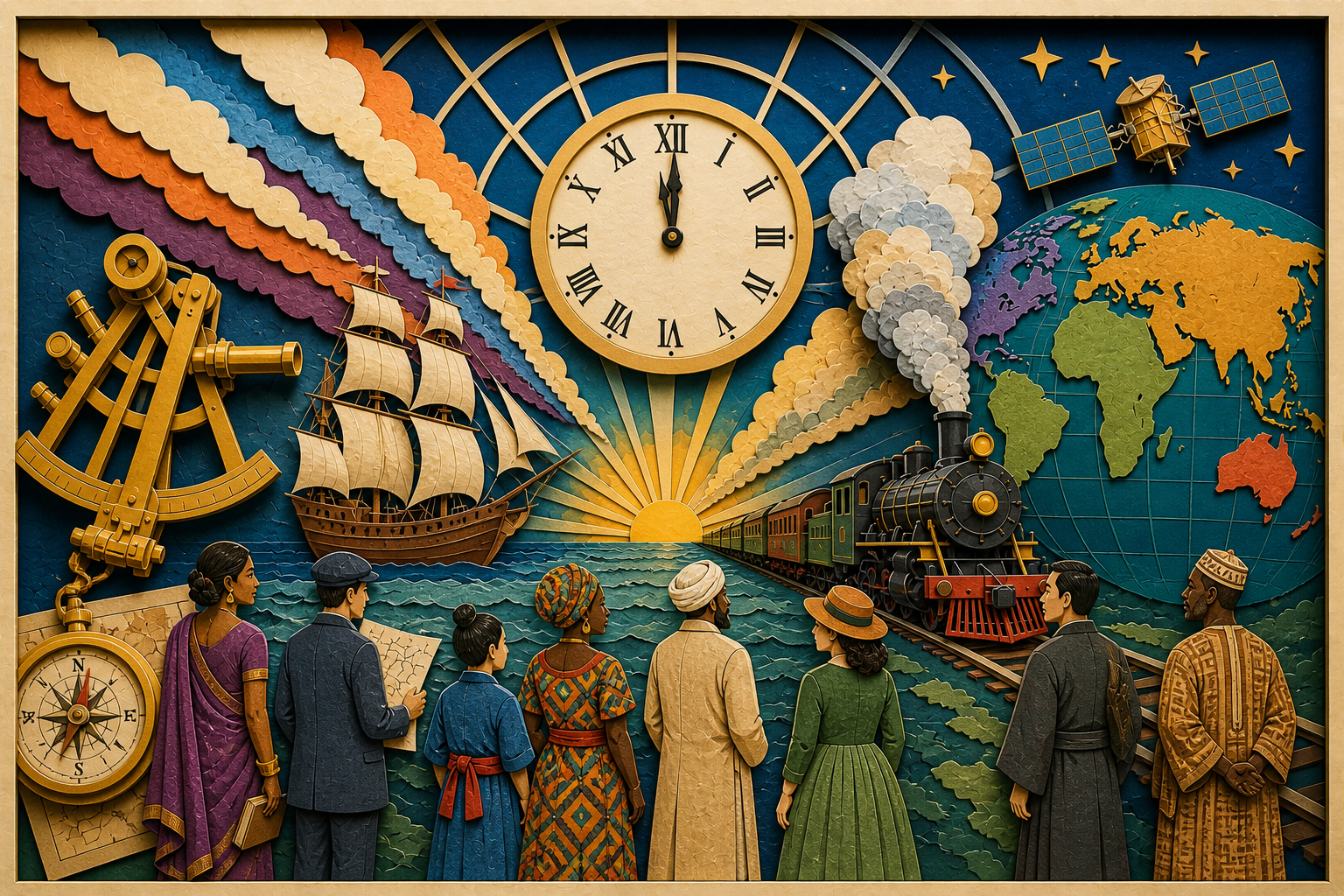

A few months ago, I found myself in Utrecht, at the Sonnenborgh Observatory in the Netherlands. Built in 1853, it was home to the Royal Dutch Meteorological Institute. For decades, one of the institute’s central functions was timekeeping—producing a reliable standard of local time that could be used for navigation, mapping, and shared across the surrounding region.
What drew me to this relatively unassuming building atop an ancient bastion was the observatory’s library. Listed as “one of the few original institute libraries to have been preserved in the Netherlands.”
While perusing the two stories of the library’s crowded shelves, I came across a book that grabbed me: Einstein’s Clocks, Poincaré’s Maps by Peter Galison. Dense at times—full of chunky vocabulary and the occasional balky sentence, the story nevertheless opened up in me a new awareness of just how important the corraling and sharing of time has been to the creation of the modern world.
My fascination with time began when I read Dava Sobel’s Longitude. In it, she shares the incredible story of how 18th-century mariners struggled to determine their positions at sea, and how the greatest minds of the age sought nature, science, and magic for answers. The solution to this navigation problem (spoiler alert) turned out to require greater precision in time tracking than had ever been conceived, nay attempted. Before we get into all that, let’s first take a brief glimpse into what exactly is time?
“What then is time? If no one asks me, I know; if I wish to explain it to him who asks, I do not know.”
St. Augustine Confessions (Book XI)1
Time can be squandered, it can be shared, it can be saved, it can be thrown out a window, it can even be turned into money. But the one thing that can’t be done with time is picked up off the street and put into your pocket. Time isn’t like gravity. It’s not “out there”. We can’t collect it like gold or store it like oxygen. We can’t measure it like, say, the speed of light. It’s not elemental like North, which you can find with a needle. There is no universal clock out there by which all that happens can be measured. Time only exists when we, the conscious observer, define it, agree upon it, and monitor it. Time is local. There is no such thing as absolute time. But that’s not what Newton told us:
“Absolute time, of itself, and from its own nature, flows equably without relation to anything external.”
Isaac Newton, The Principia
Until Einstein, Newton’s framing of absolute time stood as one of the unquestioned foundations of physics. Newton, it turned out, was mistaken. The fact of the matter is that the laws of physics do not require (nor do they support) the notion of absolute time. This is exactly what makes working with time so tricky. In the pre-industrialized world, the concept of time needed no theory. For all anyone knew, it was absolute.
Noon, it is said, can be defined as the time when the sun is at its highest point in the sky. That means my noon is my noon. Your noon is your noon, and never the twain shall meet.
It was during the Scientific Revolution that assumptions about the nature of time were tested. This was when we turned away from religious certitude and became more open toward a world we perceived as knowable. This new thinking opened the floodgates to a whole new type of question: How did things come to be? What is the origin of species? How old is the planet? How did it form? Where did we come from? What else is out there? Once we got a taste of what lay beyond the mysteries of unscientific thinking, our voracious appetite for answers turned insatiable. Of course, all that effort wasn’t in the name of exploration alone. I think Goethe put it best when, in Faust he called War and trade and piracy the indivisible trinity.2
The cracks in the foundation of ‘absolute time’ widened among mariners in the early 1600s. Expansion into the New World was in full swing. Explorers were venturing deeper into uncharted waters, reaching for the poles, circumnavigating the globe and searching for such things as the Northwest Passage and the City of Gold. Advances in ship design, food storage, nutrition, navigation tools, weapons, medicine, and even cold-weather gear made staying there easier. It was the getting there that remained the problem. This wasn’t just the Age of Sail, it was the golden age of exploration. For the first time, people had the means and wherewithal to explore the entirety of the earth.
“The revolutionary idea that defines the boundary between modern times and the past is the mastery of risk: the notion that the future is more than a whim of the gods and that men and women are not passive before nature.”
Peter Bernstein, Against the Gods
At the time, one of the great problems of conquering the world meant navigating it. Getting from here to there was one thing when you can see land. But out there, traversing the faceless ocean as you point your bow and your fortunes for the New World, that required a whole different set of skills.
Navigating the sea requires, among many other things, two points of coordinated data. Those two points are latitude and longitude. Latitude lines are imaginary lines that run east–west and measure your global position north or south. Longitude lines are similar but run north–south and help navigators get a fix on their position east or west. Knowing only your latitude and not your longitude meant you really didn’t know where your boat was. That’s bad for business.
Back in the day, calculating latitude was relatively straightforward. All you needed was a specialized piece of equipment (a sextant) and a clear view of the stars, day or night. By this method, you could determine how far north or south you were. However, as land and landmarks fell away, getting an accurate fix on one’s longitude–that posed real problems. Calculating one’s longitude turned out to be so elusive that it was considered the greatest scientific problem of the age. It’s what became defined as the longitude problem.
In an age when great distances could be traversed, the burgeoning mathematics of geodesy and the art of cartography a new problem was revealed: if your time doesn’t agree with my time, then there stands a clear and present danger to all of progress.
…and all I ask is a tall ship and a star to steer her by.
John Masefield
You might recall that Masefield quote from Star Trek V. Or you might have actually read Sea Fever. The point is that, in truth, if all you had was a ‘tall ship and a star to steer her by’, you’d likely wind up on the rocks. Or eating the cook’s cat. Or the cook.
Here is why longitude turned out to be such a problem. First of all, calculating longitude requires two things: knowing what time it is at a distant reference point and knowing what time it is on your boat. Here’s the problem: how does one maintain an accurate track of the time on board when you’re at sea? If time were absolute, then that should have been easy. But when you’re rolling about on the great and terrible ocean, how do you get an accurate fix on the time? For the generations of mariners, going as far back as Gallileo, the answer to this question boiled down to three general methods: We’ll call them stars, clocks, and…magic
Let’s start with magic (aka pseudoscience). One of the most bizarre methods by which longitude was to be resolved required wounding a dog. That’s right. I’m not making this up. Find a dog and make it bleed, you know, slash it, stab it. Wound it. Then bandage it up. When your ship leaves, take this hapless puppy, and leave behind the bandages used to treat the wound. During the voyage, at a predetermined hour back on land, these same bandages would be exposed to a substance called the “powder of sympathy.” This was supposed to cause the dog to yelp—even at great distances. Hearing the dog, the sailor would then know what time it was back at the home port. (That’s what I call spooky action at a distance.)
There were, of course, rational people in the world using truly scientific methods. Galileo, for one, proposed using the eclipses of Jupiter’s moons. Sir Isaac Newton endorsed the lunar distance method. Both techniques were about turning the heavens into a clock. Unfortunately, due to the equipment and scientific knowledge required, both schemes proved to be impractical at sea.
To catalyze a solution to this problem, in 1714, the British Parliament created the Longitude Act. Whereby anyone who could demonstrate an accurate, practical solution for determining longitude while at sea would win a prize. The amount? £20,000—click here to see how much that is in today’s dollars.
From that point, it took another 20 years for the first serious breakthrough in determining longitude to be presented to the Board. A polymath clockmaker and engineer named John Harrison developed a maritime chronometer of such accuracy, capability, and durability that it could withstand the harsh conditions encountered at sea. Over the next 24 years, he refined the device, making it compact and reliable enough to be practical. It wasn’t until 1773 that Harrison was awareded the prize, all be it grudgingly not for the full amount.4
But we’re not here to talk about ships. We’re here to talk about time. More specifically, the advancements in vehicles and speed, the burgeoning field of geodesy (the branch of mathematics dealing with the shape and area of the earth or large portions of it), and the need for cleaner definitions of exacting longitude. For these advancements to continue, the world required, nay, demanded, greater rigor and precision in managing and tracking time.
Harrison’s clocks did for time what the compass did for navigation; made it reliably portable. In a world that ran at the languid pace of sailing ships and horse-powered buggies, there wasn’t much need for greater control of time. But that all changed with the emergence of the railroad.
The Industrial Revolution brought us many things, none the least of which was the steam-powered engine in the form of the locomotive. Travel by rail introduced the world to a radical, new form of speed3. Now a journey from Paris to Orléans that once took 18 hours by coach, now could be accomplished in a single afternoon. This change in how fast goods and people could be transported changed everything about how time needed to be understood.
When railroads began connecting distant cities, an uncomfortable truth emerged: trains had to be scheduled. This wasn’t just for passenger convenience but more for train safety. For this to work, towns keeping their own “solar” time would only cause chaos. What Galison calls “the anarchy of time.”
Out of the need to keep trains on schedule and people safe, the concept of clock coordination via electrical means emerged. In any given network, there would be a master clock, from which time could be distributed via telegraph wire to all the others. What sounds like a perfectly logical solution only exacerbated the anarchy of time for one very important reason: every railroad kept its own time. The railroads weren’t the only problem. Countries used their own prime meridian to establish their own time, irrespective of what their neighbors were doing.
We learned from our experience navigating the open oceans that latitude cannot be reckoned by celestial bodies or wounded dogs. It requires the agreement of at least two clocks. The clock on board your ship must agree with the clock back on land–and keep that agreement throughout the voyage. This “knowing of latitude” is not restricted to the oceans. It’s used for mapping, surveying, navigation, artillery targeting, and you guessed it… railway planning.
“The surface of the globe is criss-crossed by trains riding on rails, by fast boats full of voyagers and merchandise, and on the aerial and submarine telegraphic lines, news circulates with the speed of light. . . . The surface of the planet has been, in a certain sense, contracted.”
Henri Poincaré5
By 1897–98, however, all of this came to a head in what Peter Galison called the “telegraphic time crisis.” There is much that could be said about it, but at its core, it was the collision of three forces: The railroads’ demands for synchronized time. The advent of the telegraph and then the radio for transmission of signals across vast distances. And the science of measuring the Earth. It was this science, known as geodesy, that required such precision that things started to come apart.
Despite all this progress, no single “correct” time could be established across distance. Telegraph relays introduced delays. Observatories followed different protocols. What looked like a unified system began to fracture under scrutiny.
A direct example from Gallison’s book makes the problem concrete. The English longitudinal difference from Paris to London was measured as 9 minutes and 20.85 seconds. The French measurement turned out to be: 9 minutes and 21.06 seconds. That’s a discrepancy of about a fifth of a second. Doesn’t sound like a lot. If your data doesn’t match up, roads won’t meet. Borders won’t align. The river that’s supposed to be there isn’t!
Consider how you navigate today. Most of us use map software our phones. It works because everyone agrees on a shared coordinate system. That agreement is so complete—so invisible—that it feels like a natural fact about the world. But it isn’t. As we’ve seen, there was a time when even something as basic as agreeing on the time—let alone your position on the globe—was deeply uncertain.
In his 1905 paper on special relativity, Einstein demonstrated how synchronizing clocks via telegraphic measures did not create clock synchronization. A central clock would send out a signal, and every other clock would simply set itself to that time upon receiving it. If the signal left at 3:00 p.m., each clock would read 3:00 the moment the pulse arrived. The problem, as Einstein pointed out, is that those clocks sit at different distances from the source. The signal takes time to travel. Clocks nearby would be set first, distant ones later—so what looked like synchronization was, in fact, not.6
In Elective Affinities, one of Goethe’s characters says that “consciousness alone is not an adequate weapon.” I take that to mean that just because we have an awareness of something, it doesn’t mean we actually have control of it. We like to imagine ourselves as standing apart from the world, imposing order upon it. Crack the whip, and it dances. Time does not yield to intention. It demands instruments, systems, networks, and people who act to coordinate it.
These systems work because we agree on them, not because the universe guarantees them. Precision and innovation require more than a passing understanding of the forces that shape our lives. Why, then, do we drive ourselves to such extremes? Maybe Genesis offers a clue:
“Be fruitful and multiply, and fill the earth and subdue it, and have dominion over the fish of the sea and over the birds of the heavens and over every living thing that moves on the earth.”
Genesis 1:28 (ESV)7
What followed was not the discovery of a single, universal time, but the construction of one. We chose a meridian.8 We divided the world into time zones. We synchronized clocks by wire, then by radio, then by satellites orbiting overhead. We built atomic clocks to keep time steady, and corrected it with Einstein’s equations when it drifted. Step by step, agreement replaced ambiguity. Not because we found time waiting for us, ready to be picked up and carried, but because we learned how to work with it—Together.
“The absence of time does not mean, therefore, that everything is frozen and unmoving. It means that the incessant happening that wearies the world is not ordered along a timeline, is not measured by a gigantic tick-tocking…it is a boundless and disorderly network of quantum events.”
—Carlo Rovelli, The Order of Time
What this history reveals is not just a story about clocks and maps, but something more fundamental about us. At every step, we believed we were uncovering a deeper, more precise structure of the world—only to discover that what we needed depended on agreement, assumption, and constant adjustment with one another.
And that is the quiet truth beneath all of this. The modern world doesn’t hold together because we mastered time. But rather because we found ways—imperfect, contested, and hard-won—to work together. To agree on it. Not in a vacuum. Not by decree. Not on the back of any one nation or mind alone. But together.
This is the effort we must continue to pursue. To defend our minds against the tyranny of fear and ignorance. To remove the blinders and barriers that separate us. Promote learning, science, education, and peace. That’s how I’d like to see progress happen.
On this, our spaceship Earth, remember we’re all in it together.
“For we ourselves are chisel and statue, conquerors and conquered at the same time — it is a true transforming of oneself by ‘self conquering’. (Selbstüberwindung).”
Schrödinger, What is Life?9
Footnotes
1Even though I own St. Augustine’s Confessions, which I highly recommend to everyone–whether you’re religious or not , I hadn’t fully appreciated this passage until it was quoted by Carlo Rovelli in his masterpiece The Order of Time. If you haven’t tasted of the Rovelli, think of it as physics written from the heart of a poet.
2Faust as mentioned in Goethe Life as a Work of Art by Rüdiger Safranski. When I started this article, I just happened to be just finishing this book. It’s basically a survey of Goethe’s life and work.
3People were understandably freaked out as steam power began to overtake horsepower. No wonder it was widely circulated that your eyeballs might fly out of your head…and the breakneck speed of… 70mph. Locomotive power was considered “the emancipation from nature.” For more about the philosophical implications of the locomotive, and “how the perceptions of distance, time, autonomy, speed, and risk were altered by railway travel,” see Wolfgang Schivelbusch’s The Railway Journey: The Industrialization of Time and Space in the Nineteenth Century
4To see all four of these clocks in action, I highly recommend a visit to the Royal Observatory in Greenwich, England. In my book reviews I uploaded the photos I took of the clocks when I was there.
5From Einstein’s Clocks and Poincare’s Maps: Empires of Time (pp. 31-32): “Some seven years before the twenty-six-year-old patent officer [Einstein] redefined simultaneity in his 1905 relativity paper, Henri Poincaré had advanced strikingly similar ideas. A cultured intellectual, Poincaré was widely acclaimed as one of the greatest of nineteenth-century mathematicians for his invention of a great part of topology, his celestial mechanics, his enormous contributions to the electrodynamics of moving bodies.”
6ibid, page 20. What remained elusive was the notion of simultaneity. Simultaneity is defined as the condition in which two events occur at the same time, even when separated by distance. Conceptually, one might think this is easily done, but mechanically, to actually know, as Einstein pointed out, was damn near impossible.
7I struggle with the fact that the narrative Genesis tells man to dominate the world and everything in it. Perhaps this is exactly why we have real environmental problems today. What damage has been wrought by that one passage?
8A good story here too. Galison points out the adoption of Greenwich as the prime meridian was as much a political battle as a scientific one. France, long committed to the Paris meridian, resisted the change, but Britain’s dominance in global navigation ultimately made Greenwich unavoidable. (again, a good place to visit if you find yourself in and around London)
9Around the time of writing this post, I was finishing Schrödinger’s book What is Life. It’s a short work, but it has taken me months to get through it. It’s heavy and light, technical and dreamy all at the same time. I couldn’t deny how this quote made me feel in the grand scope of this writing.